
UEBB Wearables · Apps for smart glasses

Hands on the machine, data in the lens.

We build smart glasses apps for people who work with their hands full: the data of the machine in front of them, the procedure step by step, an expert colleague who sees what they see. We start with Meta Ray-Ban Display, but the app doesn't depend on the glasses, and the data stays on your servers.

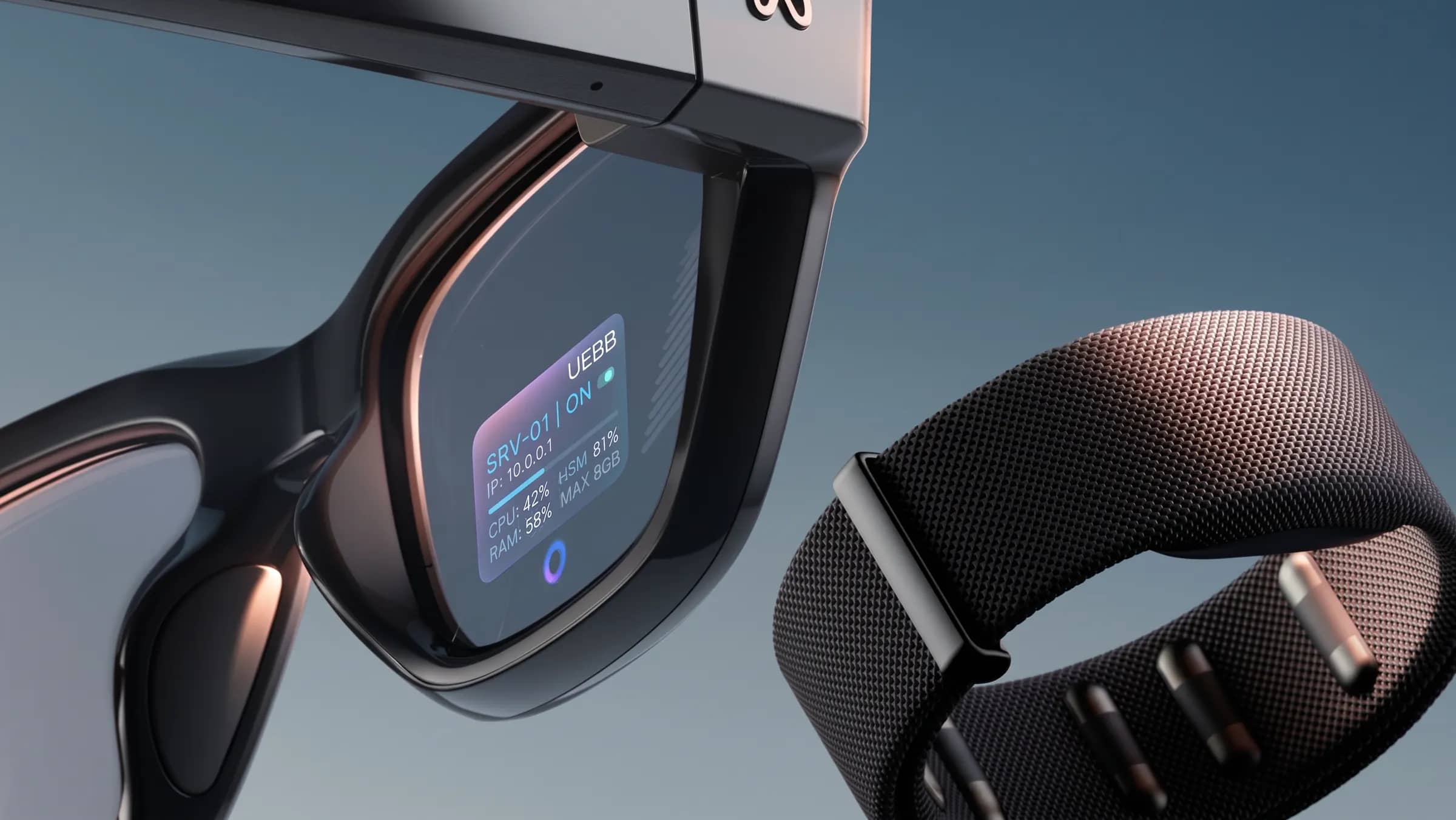
Rendering of Meta Ray-Ban Display glasses with a UEBB app in the right lens: server SRV-01 on, CPU at 42%, RAM at 58%. Next to it, the Meta Neural Band.
Rendering of a UEBB app on Meta Ray-Ban Display

Try them at our office, by appointment.

Ten minutes wearing the glasses, at Via Staurenghi 34 in Varese, is enough to see whether they can help on your shop floor.

What changes on the shop floor

The work stays the same. What changes is where the information arrives.

Glasses don't replace anyone and don't do the job for the people who know how to do it. They bring information the company already has, in its systems or in a colleague's experience, to the exact point where it's needed.

An alarm on the line
TodayThe technician walks to the operator panel, reads the code, walks back to the machine and looks for the point to check.
With glassesThe code and the point to check appear in the lens while they are already standing at the machine.
A fault that happens once a year
TodaySomeone phones the expert colleague and tries to describe what they see.
With glassesThe colleague sees what the technician sees and answers with a note or an image, in the lens.
A new hire
TodayThey learn by shadowing an experienced colleague, who slows down their own work in the meantime.
With glassesThey have the procedure in front of their eyes, one step at a time, even when working alone.
Quality control
TodayA paper form at the end of the line, which someone later types into the ERP.
With glassesThe checklist scrolls in the lens, the result is confirmed with a gesture and reaches the ERP together with the batch.
Service at a customer site
TodayThe field technician works on a machine they know less well, with the manual on their phone.
With glassesData sheets, service history and the engineering office are a glance away.

What the wearer sees

Six apps we can build for your shop floor.

Machines and PLCs

A QR code on the machine, the PLC values

Just look at the label. The camera reads the code, the app asks an OPC UA gateway on your network for the data, and the lens shows pressure, temperature, cycle time and active alarms of that machine. Read-only.

Production lines

The line cycle, station by station

On a line of machines in series, each with its own PLC, the lens shows the state of every station, the cycle times and the parts waiting between one and the next. The bottleneck stands out at a glance, and the technician knows where to go before the line stops.

Maintenance

The manual, one step at a time

That machine's procedure split into short steps, with pictures and tightening torques. A flick of the wrist moves on and the hands stay on the tool. Regulation (EU) 2023/1230 allows instructions in digital form: these really are.

Warehouse and ERP

The ERP, without a terminal in hand

Location, quantity and lot of the next pick; a pinch confirms and the movement lands in the ERP. Works with SAP, the most common ERPs and custom software, through APIs or connectors.

Support

The expert sees what you see

The camera video goes from the phone to a server in your company and on to the colleague in the office, who replies with a note or an annotated picture, right in the lens. No third-party video-call platform.

Safety

PPE and permits, before you walk in

The QR code at the entrance of an area shows the protective equipment required, the status of the work permit and the machines that are handed over or locked out. The information comes from your system, current at that moment.

Simulator

Try the lens, in your browser.

The frame reproduces the glasses display: 600 × 600 points, black where the lens is transparent. On the real glasses you navigate with the Neural Band, and in web apps for Ray-Ban Display its gestures arrive as arrow keys, Enter and Escape. We use the same keys here: click the lens and try.

From gestures to keys

Thumb sliding along the index finger
↑ ↓
Thumb and index finger pinch
Enter
Thumb and middle finger pinch
Esc

ST1 Loading: Running, 12.1 s

Simulated data. On the Machine tab, wait a few seconds.

The AI behind the lens

The glasses look, our models understand.

The glasses are a screen and a camera. The rest is done by the models we have been building for industry for years, and they run on your servers: no third-party cloud, no data leaving the plant.

All on-premise

Models served on NVIDIA GPUs in your server room, or in an Italian datacentre if you prefer.

How we do on-premise AI →

Privacy first

Where the data goes, and where it does not.

The glasses are a Meta device, but the app is ours and the data is yours. The path is short: from the glasses to the phone, from the phone to your servers.

MetaCLOUDSDK TELEMETRYOFFYOUR PERIMETERGlassesDISPLAY · CAMERA · MICROPHONESBLUETOOTH · LOCAL WI-FIPAIRINGUEBBPhoneUEBB APP · YOUR CODECOMPANY NETWORK · VPNYour serversERP · BUSINESS SOFTWAREOPC UA GATEWAY → PLCAI MODELS ON GPUSMANUALS AND PROCEDURES

The code stays yours

The app runs on the phone and we hand it over with the source code. Meta doesn't receive the code: to distribute it to the glasses, only its name, icon, version and permissions are registered.

Images don't go through Meta

Camera video goes from the glasses to the phone over Bluetooth and local Wi-Fi, then to your servers. The QR code is decoded on the phone and frames are not stored, unless you decide otherwise.

Telemetry off

By default Meta's SDK collects operational data: device identifiers, versions, session durations, errors. Meta lets developers switch it off, and in our apps we do.

A camera on the shop floor is also an employment matter

In Italy, article 4 of the Workers’ Statute requires a union agreement or a labour inspectorate authorisation for tools that allow remote monitoring of workers, and exempts the tools used to perform the job. We design the apps so the line is clear: a precise purpose, no continuous recording, minimal retention. We help with the privacy notice, the impact assessment and the technical documentation for the agreement.

Read the article (in Italian): glasses in the factory and article 4 →

Independent of the glasses

Glasses will change. Your software stays.

The logic of our apps lives on the phone and on your servers; the glasses are the screen and the camera. When a new model arrives, we rewrite the last mile, not the project.

  • TodayMeta Ray-Ban DisplayDisplay, camera and Neural Band. In Italy from 13 October 2026.
  • TodayRay-Ban Meta and Oakley MetaNo display: camera, microphones and speakers. Answers come by voice.
  • ComingAndroid XRGoogle's glasses with Samsung, Warby Parker and Gentle Monster. The SDK is in preview; display models are expected in 2027.
  • ComingSnap SpecsSnap's AR glasses, announced for 2026 in the United States, the United Kingdom and France.
  • On requestRealWear, VuzixRugged Android headsets for industry, built for harsh environments.

How we work

From the shop floor to the lens.

  1. 01

    Site visit

    We come to the shop floor and pick one case with you: the one where busy hands cost the most.

  2. 02

    Prototype

    A working app on one pair of glasses, connected to real data: PLC, line or ERP.

  3. 03

    Pilot

    A few weeks with your technicians. Meanwhile we prepare the privacy notice, the impact assessment and the documents for the agreement together.

  4. 04

    Release

    Private distribution to your devices, updates and support. The source code stays with you.

Frequently asked questions

Which smart glasses do you support?

Today Meta Ray-Ban Display, with display and Neural Band, and Ray-Ban Meta and Oakley Meta without a display, for apps that answer by voice. We follow Android XR and Snap and, for the harshest environments, industrial headsets such as RealWear and Vuzix. The app's logic lives on the phone and the servers, so changing glasses doesn't mean redoing the project.

Do the glasses need a display?

No. Glasses without a display, such as Ray-Ban Meta, have a camera, microphones and speakers: the app answers by voice. With a display, such as Meta Ray-Ban Display, the value is read in the lens and confirmed with a gesture. In a noisy plant reading almost always beats listening, but for an inspection round guided by voice the simpler version may be enough.

Does company data go through Meta?

No. Video and data travel from the glasses to the phone over Bluetooth and local Wi-Fi, and from the phone to your servers. What goes through Meta is the pairing of the glasses, done with the Meta AI app, and the SDK telemetry, which we switch off in our apps.

How are PLC data read?

Through a gateway on your network speaking OPC UA, Modbus or Siemens S7 protocols, read-only unless more is needed. The app recognises the QR code on the machine and asks the gateway for that machine's values: the glasses never touch the PLC.

Can they be used with prescription lenses?

Yes, Meta Ray-Ban Display can be fitted with prescription lenses at authorised opticians.

Do they replace safety glasses?

No. Meta Ray-Ban Display is not personal protective equipment, and Meta itself warns against using it as safety glasses. Where the risk assessment calls for protective eyewear, for example near lathes, mills or grinders, other options are needed, such as RealWear industrial headsets, which are worn with a hard hat and safety glasses. We assess it together during the site visit.

How much does a project cost?

It depends on the case. To start, we pick a single process and data you already have, so the prototype is cheap and you quickly see whether it's worth it. The glasses are bought separately: we help you choose the model that suits your shop floor, which isn't always the newest one.

How does the app get onto the technicians' glasses?

Today Meta distributes third-party apps through private channels with invited users: for a company that is the right way, because the app only reaches your technicians. Open publishing in Meta's catalogue is not available yet, and a company app doesn't need it.

Is a union agreement needed?

It depends on how they are used. Under Italian law, if the glasses are used to perform the job, article 4 of the Workers’ Statute requires neither agreement nor authorisation; if they also allow remote monitoring, it does. The line must be assessed case by case with your labour consultant: we design the app so it is clear and give you the technical documentation you need.

Do you only work in the province of Varese?

We are based in Varese, Italy, and come to your plant for the site visit and the pilot. Development, releases and support also work remotely, so we can serve companies across Italy.

Do you build the same app for phones and tablets?

Yes, mobile apps have always been our trade. Often the same app has two screens: the phone for those who prefer it, the lens for those with busy hands.
Do you have a department where hands are always busy?

Tell us about the process. We'll tell you frankly whether glasses really help, and where to start.

Trademarks

Meta, the Meta logo, Meta Ray-Ban Display, Meta Neural Band and Meta AI are trademarks or registered trademarks of Meta Platforms, Inc. Ray-Ban and Oakley, and their logos, are registered trademarks of Luxottica Group S.p.A. and Oakley, Inc., EssilorLuxottica group companies. Android XR is a trademark of Google LLC, Snap and Specs of Snap Inc.; RealWear and Vuzix belong to their respective owners. Trademarks and logos appear on this page, rendering included, only to identify the devices we develop for.

UEBB is an independent developer: it is not affiliated with Meta or EssilorLuxottica, which do not sponsor or endorse this site. The opening image is a rendering. Availability dates as announced by Meta in September 2026.