
GA.IA — An intelligent control room for the whole supply chain.
GA.IA — Gestione Avanzata Intelligente Artificiale — integrates nine machine learning technologies in a single platform: SKU-level demand forecasting, production planning, scenario simulation, supplier risk, shipment control tower, quality and market intelligence, with explained recommendations, not just numbers.
It integrates with the systems you already have — from SAP to third-party software — and with the databases you use. Cloud or on-premise.
Interface
Control room, dark and light
Configurable KPIs, prioritized alerts and a GA.IA recommendation next to every indicator. Light or dark theme, desktop and mobile.
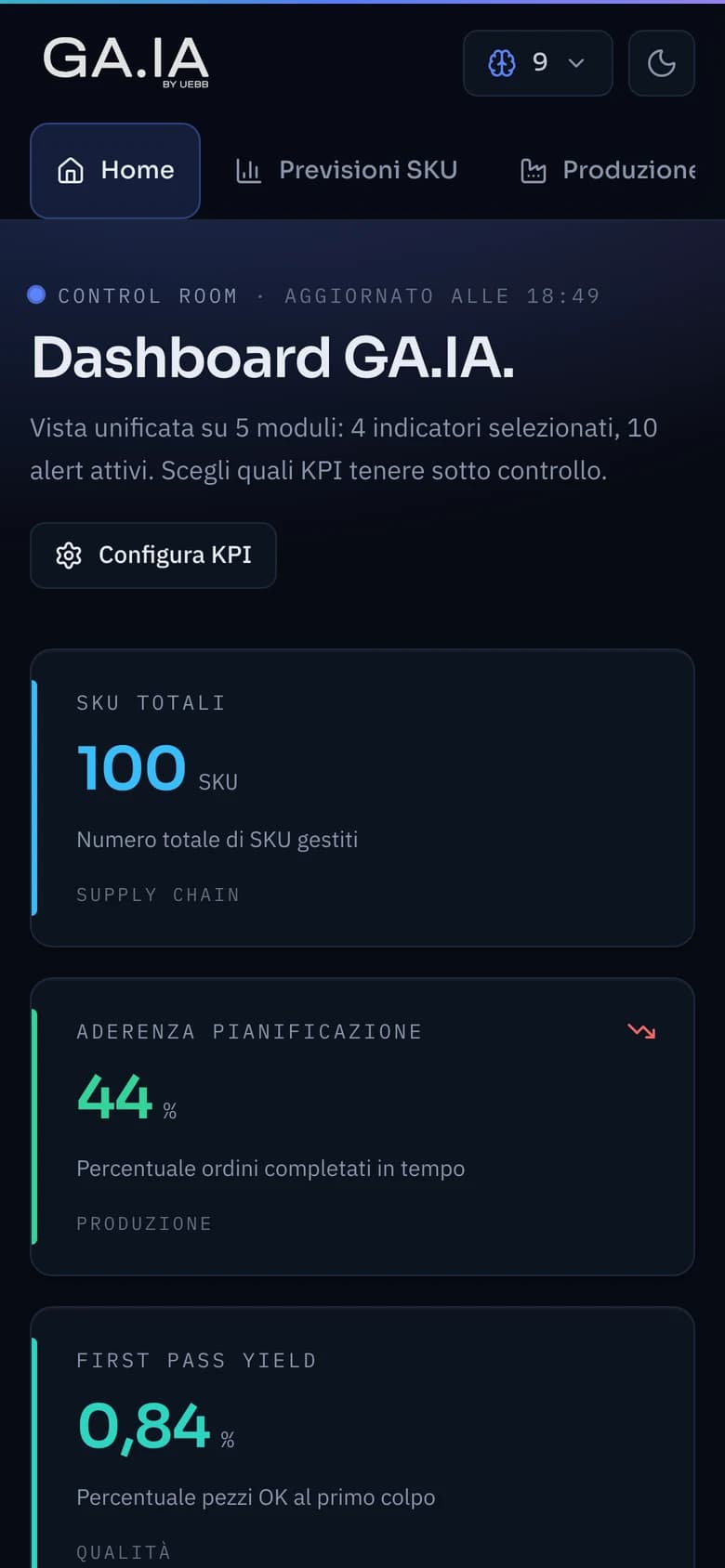
Dashboard · mobile
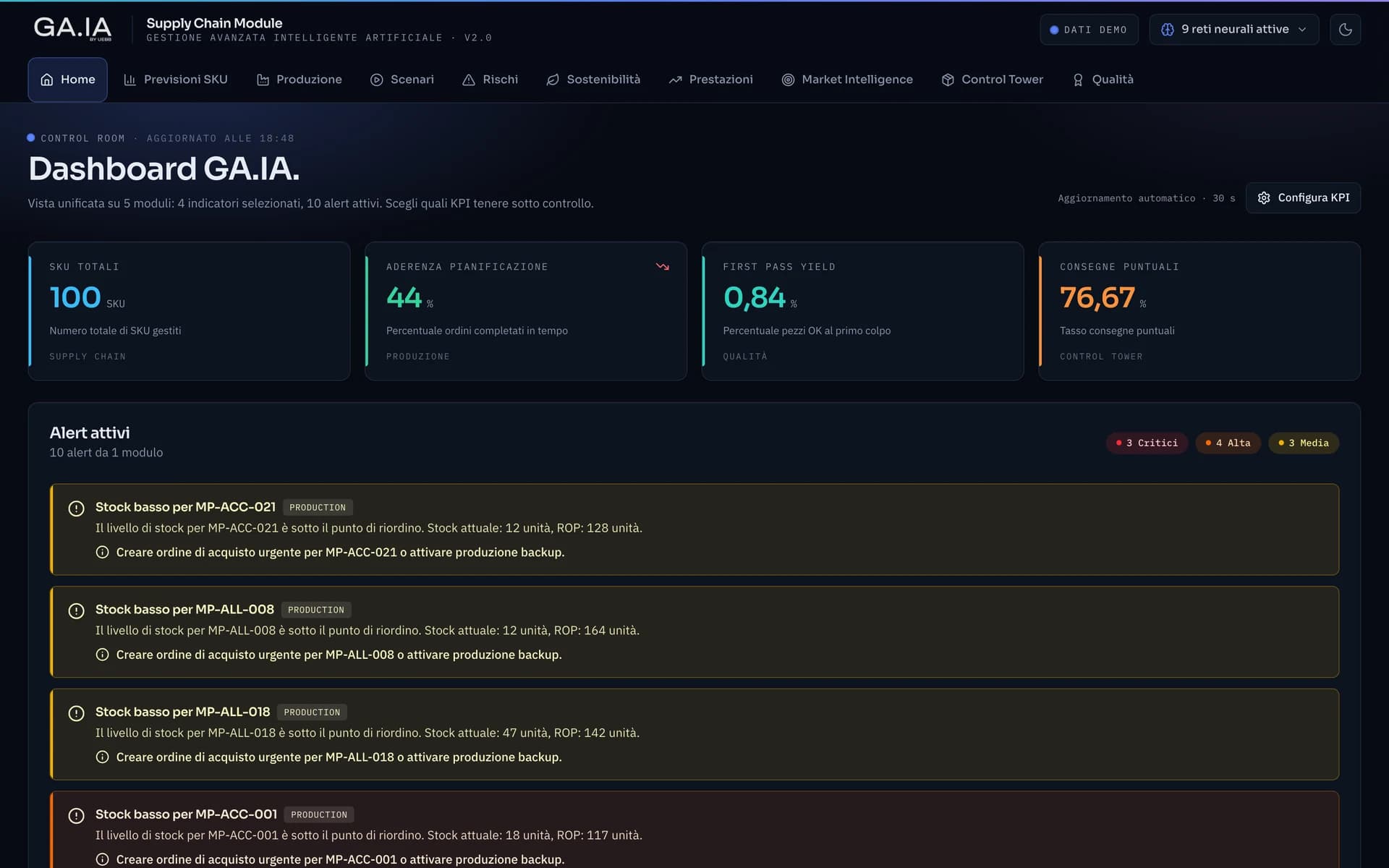
Dashboard · control room
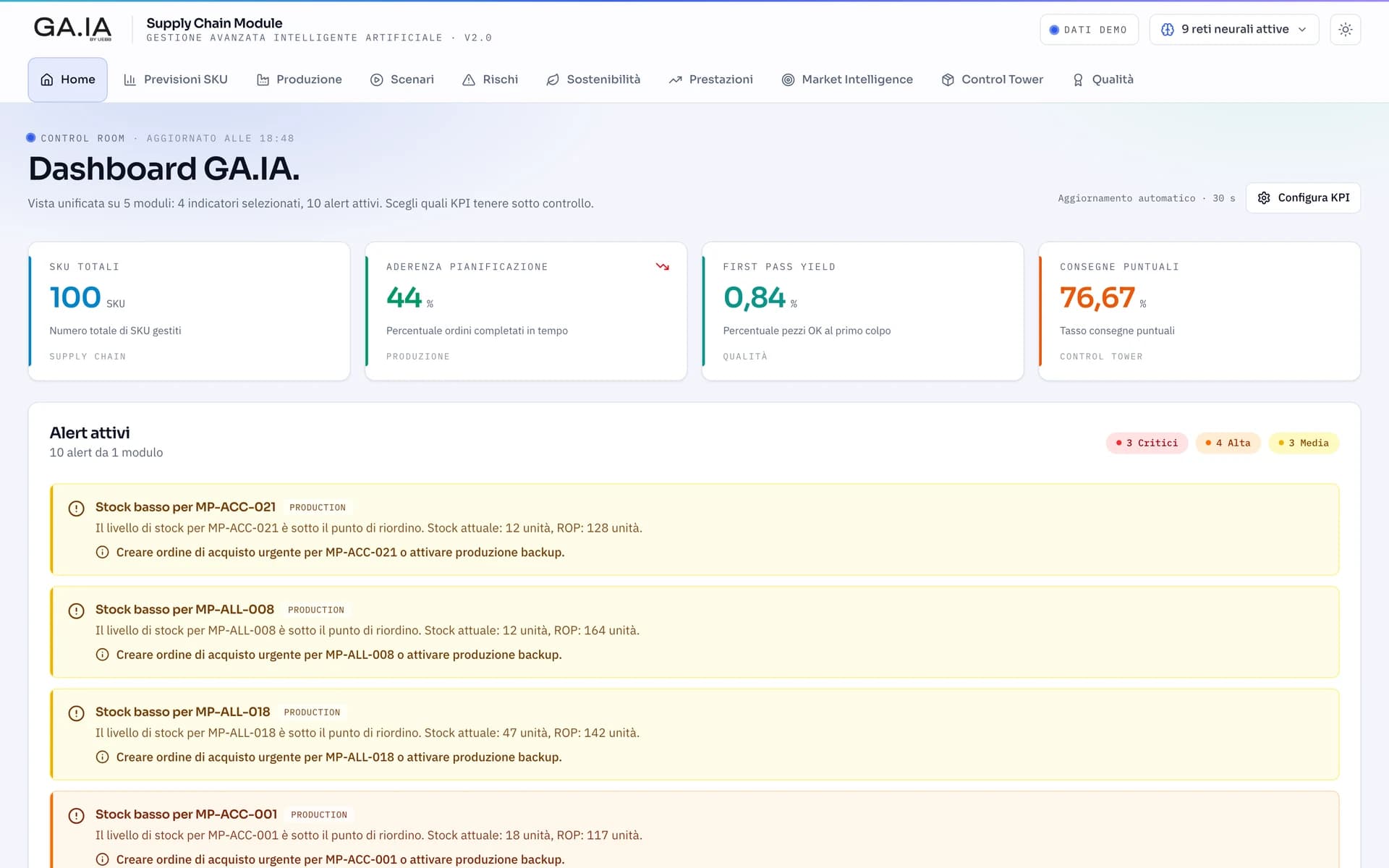
The engine
Nine technologies, one system
Each model does one thing well; together they cover forecasting, anomalies, segmentation, classification and language. On top, a reinforcement learning agent trains continuously on real shipments.
LSTM (PyTorch)
01Recurrent neural network for time-series demand forecasting
Prophet (Meta)
02Time series forecasting with trend and seasonality
XGBoost
03Gradient boosting for classification and regression
Ensemble
04LSTM + Prophet + XGBoost combined for maximum accuracy
K-Means
05Clustering for demand segmentation
UMAP
06Dimensionality reduction for visualization
Isolation Forest
07Anomaly detection for unusual events
Random Forest
08Decision-tree ensemble for classification
DistilBERT
09Transformer for text sentiment analysis
The modules
Ten views, one chain
Control room
Unified view across all modules: KPIs of your choice, prioritized alerts, GA.IA recommendations.
SKU forecasts
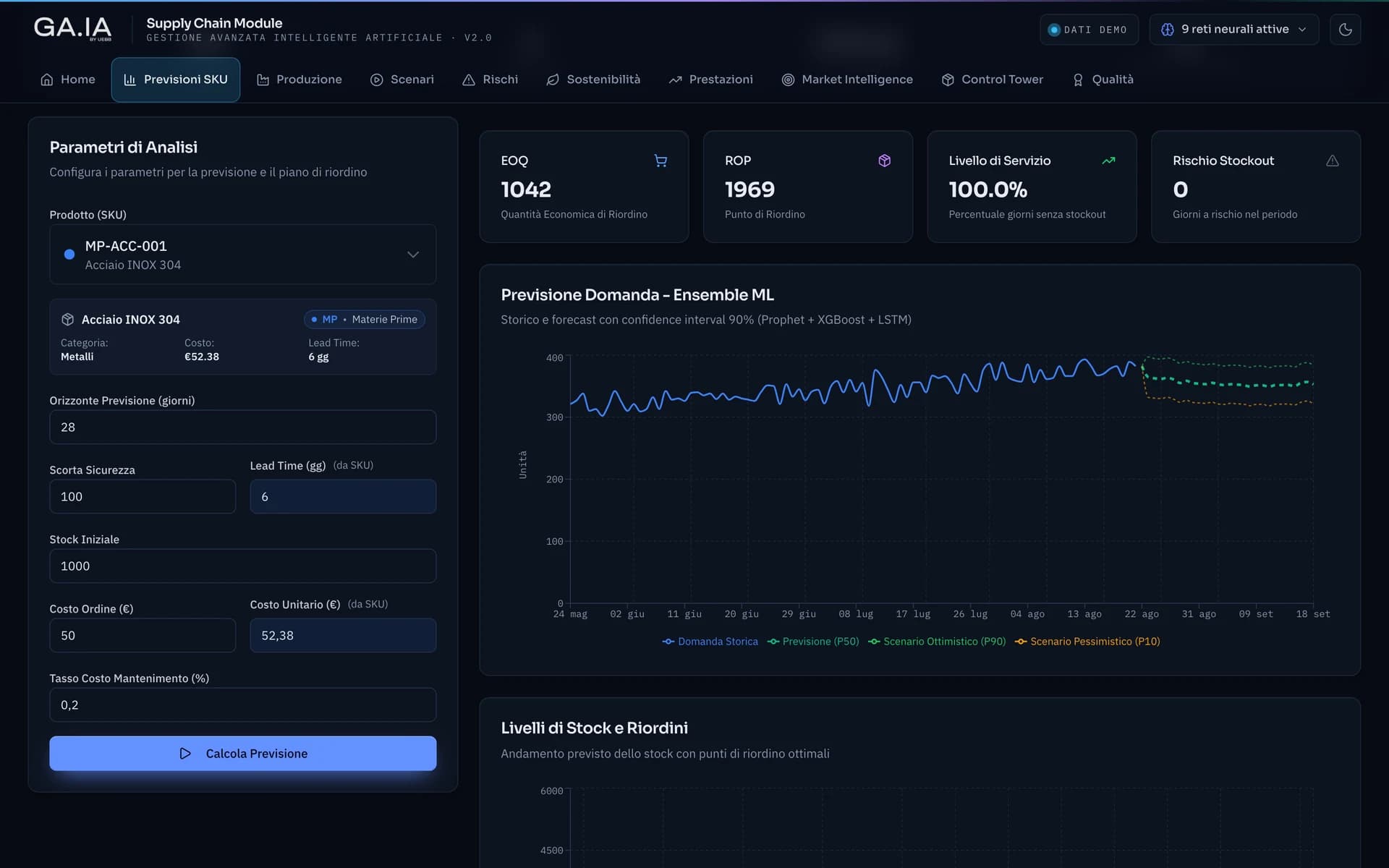
Ensemble forecast with 90% confidence interval, EOQ, reorder point, service level and stockout risk.
Production
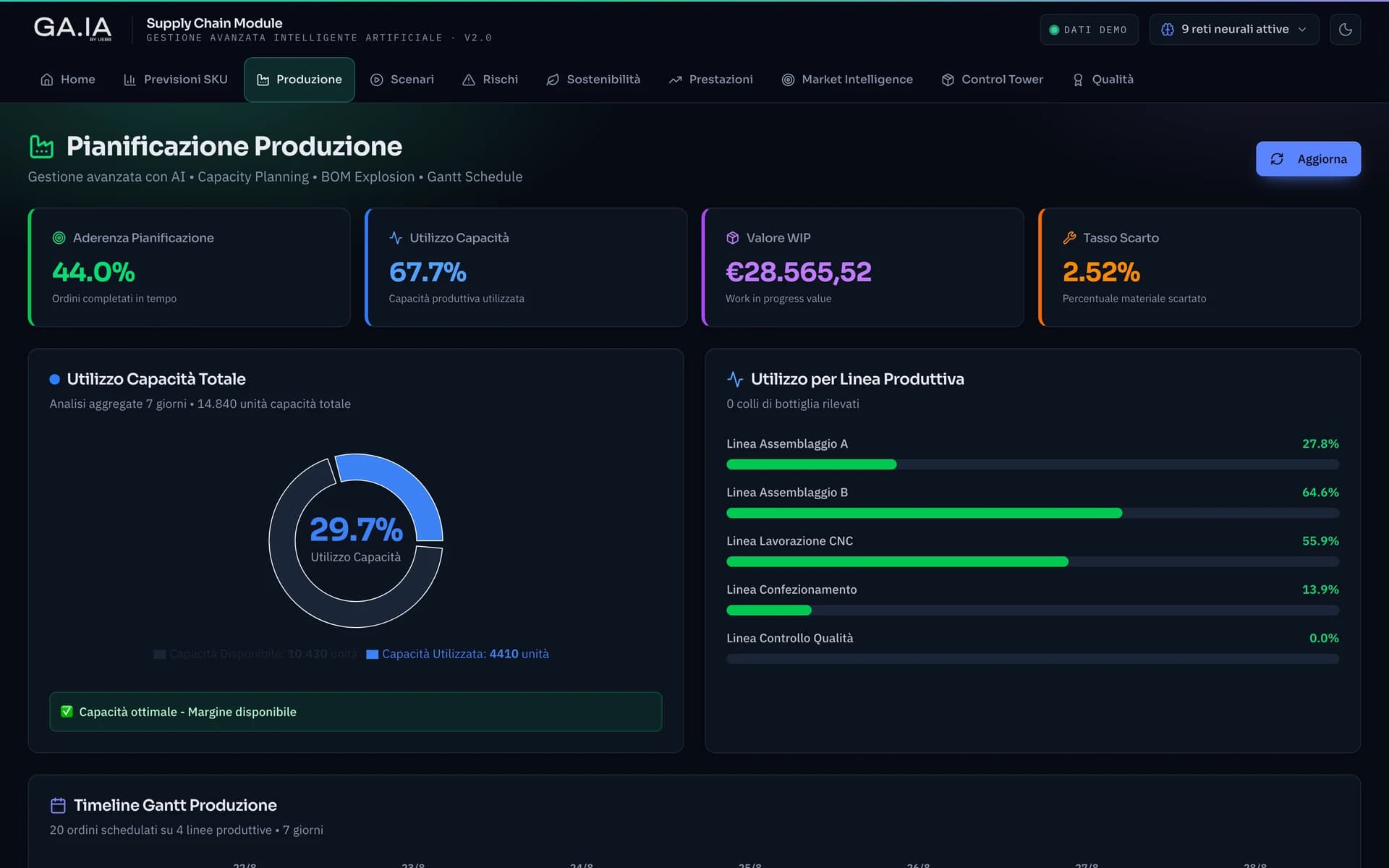
Capacity planning, BOM explosion, Gantt, utilization per line and bottlenecks.
Scenarios
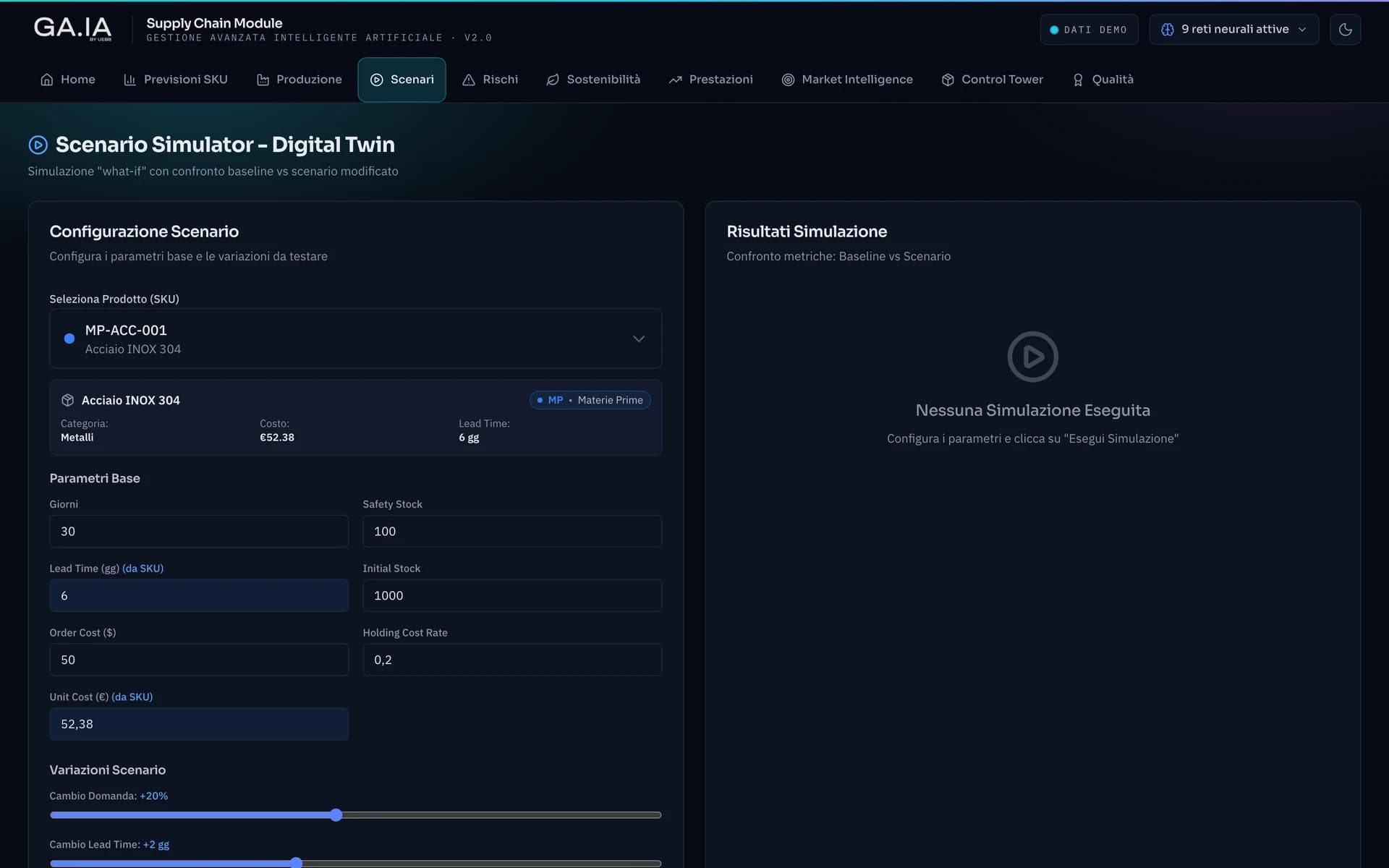
What-if digital twin: demand and lead-time changes, baseline vs scenario comparison.
Risks
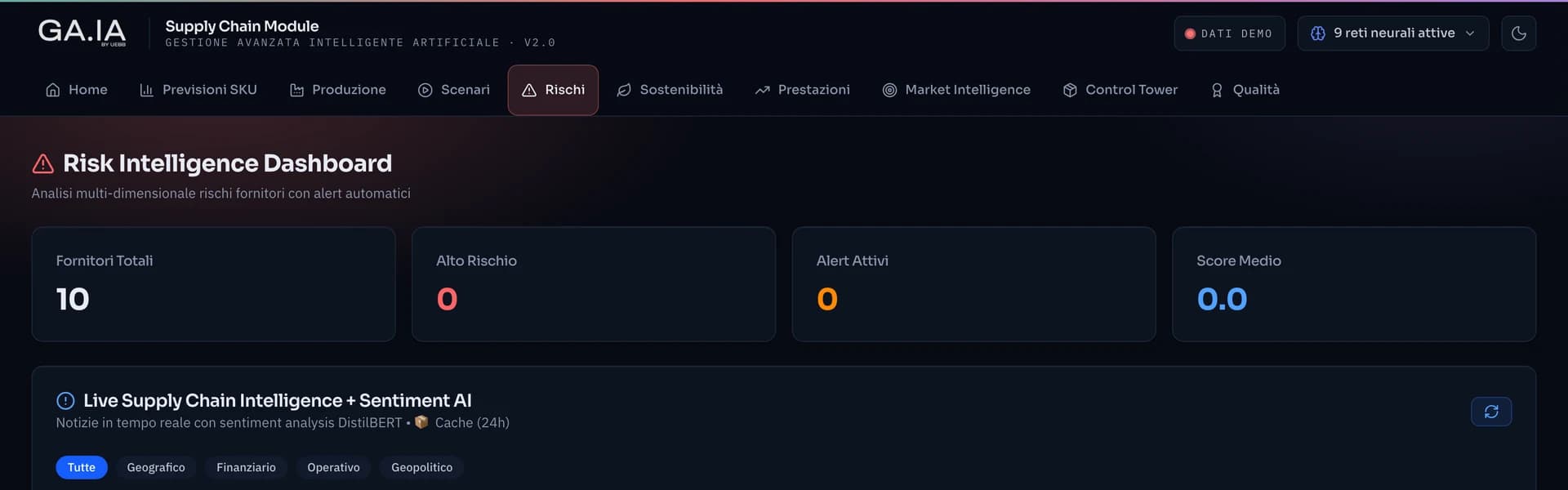
Supplier risk intelligence and real-time news with sentiment analysis.
Sustainability
Sustainability indicators along the chain, next to cost and service.
Performance
End-to-end performance KPIs to measure what changes.
Market Intelligence
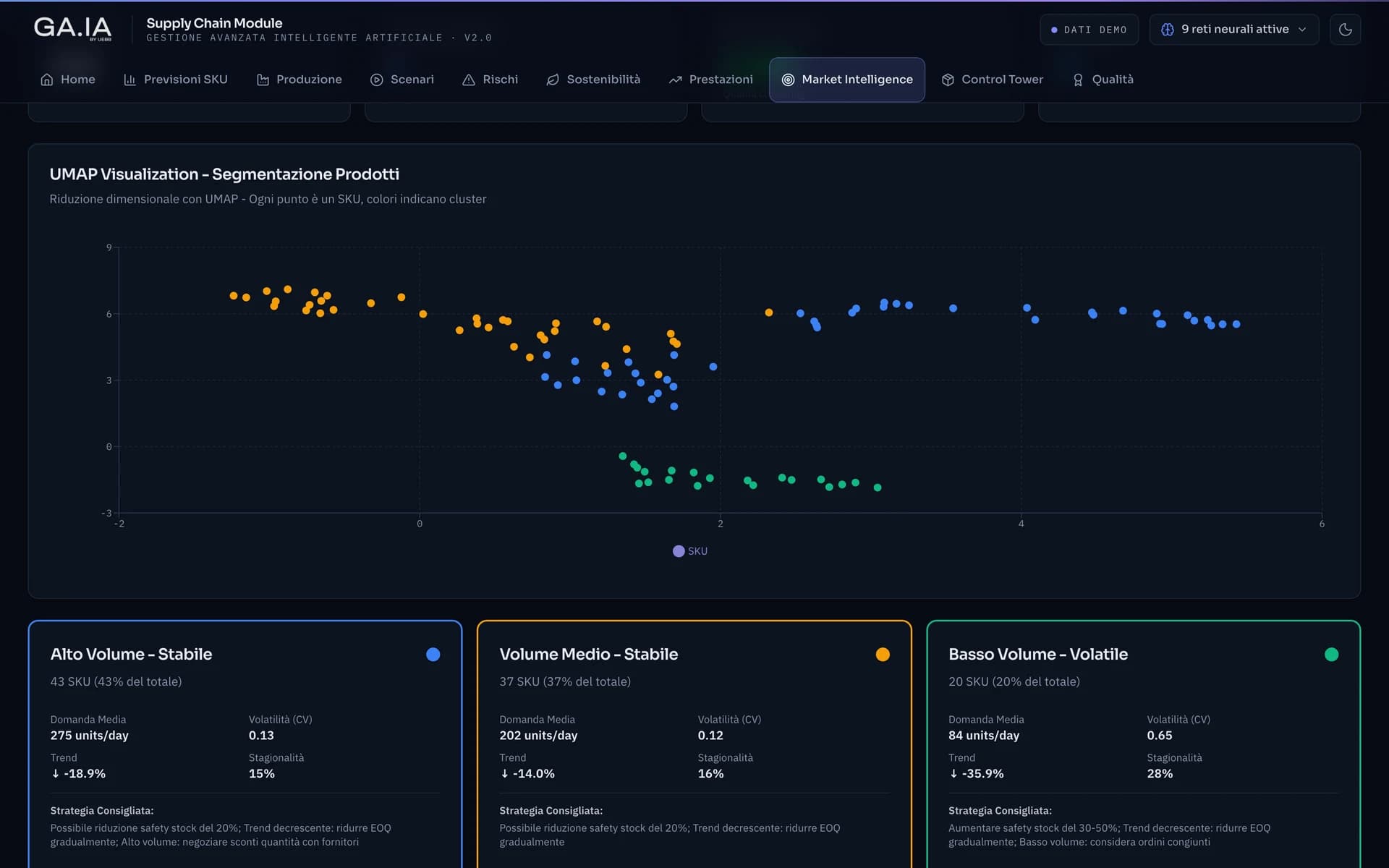
UMAP segmentation of SKUs into clusters with recommended strategy (safety stock, EOQ, orders).
Control Tower
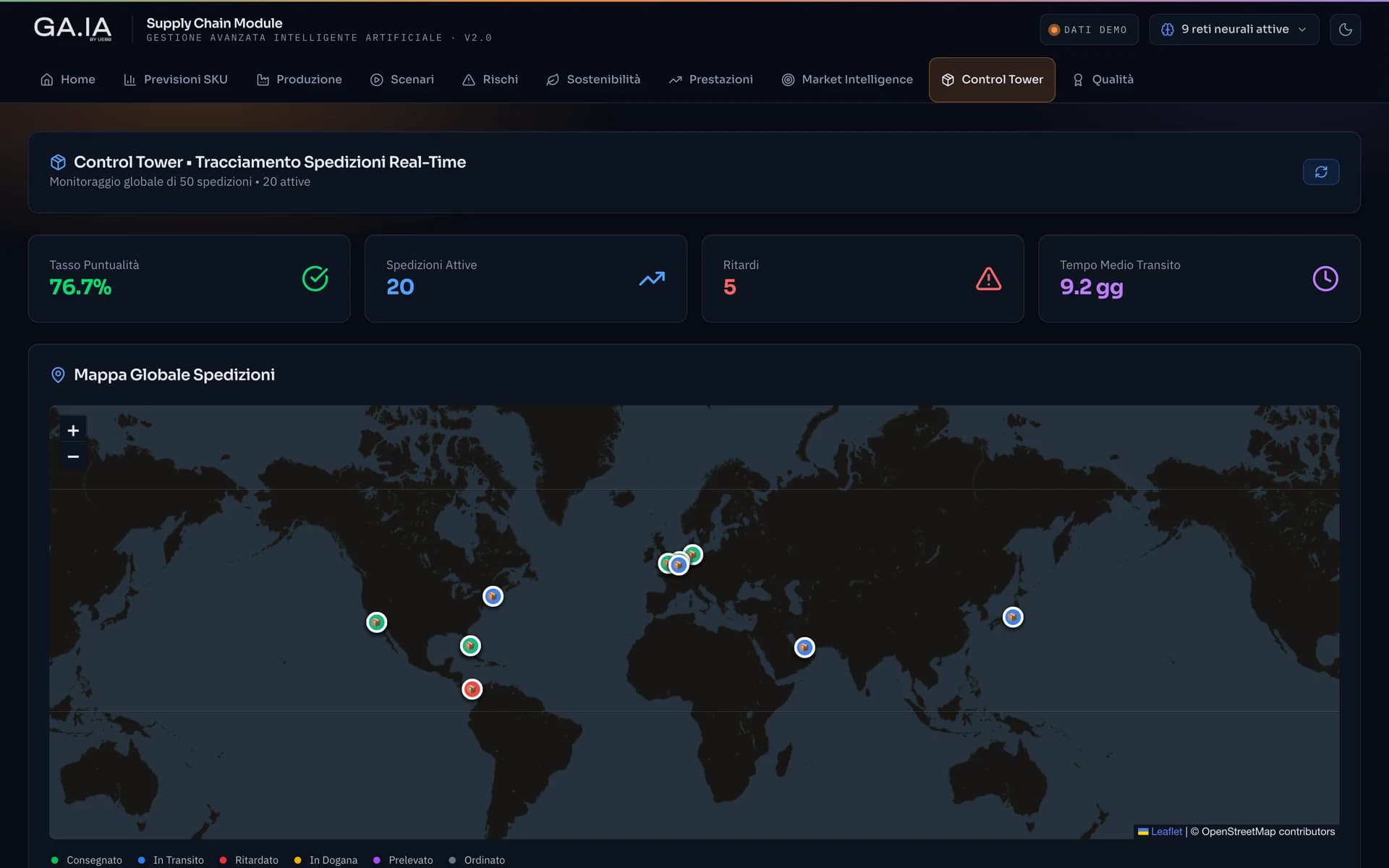
Real-time shipment tracking on a map: on-time rate, delays, average transit time.
Quality
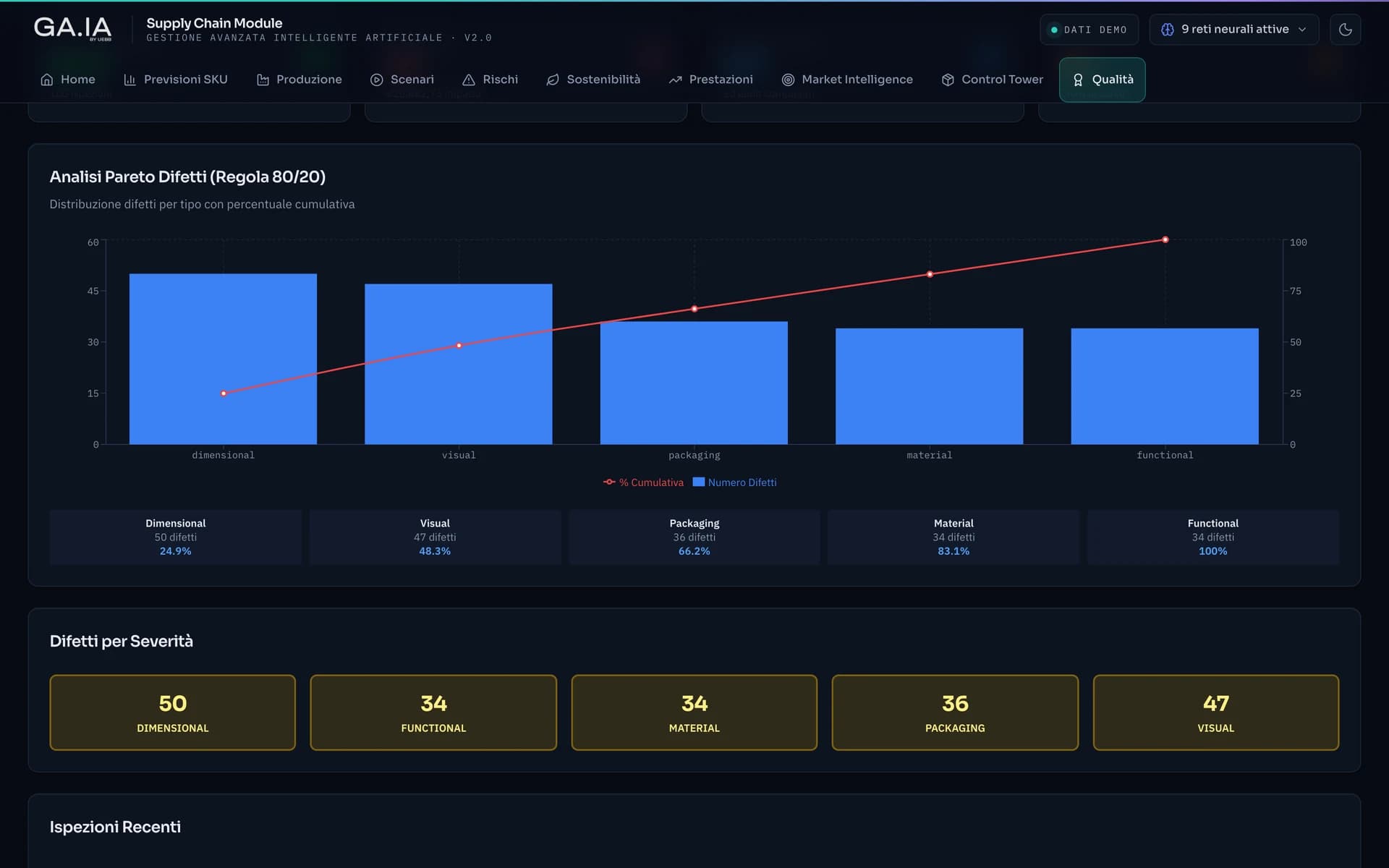
80/20 defect Pareto, defects by severity, inspections and ML classification.
Inside GA.IA
Forecast demand with an interval, not a number
History and forecast with 90% confidence interval (Prophet + XGBoost + LSTM), P10/P50/P90 scenarios, computed EOQ and ROP, projected stock levels and a reorder plan with dates and quantities.
Plan production on real capacity
Plan adherence, capacity utilization, WIP value and scrap rate; utilization per line, bottlenecks and a Gantt timeline of scheduled orders.
See shipments while they move
Control tower with a global map, status of every shipment, on-time rate, delays and average transit time — plus anomalies flagged by the models.
Segment the portfolio and decide by cluster
UMAP reduces dimensions, K-Means groups the SKUs: for each cluster volume, volatility, trend, seasonality and a recommended strategy.
Simulate first, then decide
Digital twin: change demand and lead time, tweak base parameters and compare baseline and scenario on the metrics that matter.
Quality that shows where to act
Defect Pareto analysis, distribution by severity, recent inspections and ML defect classification.
Supplier risk with the news inside
Multi-dimensional risk score per supplier and a real-time news feed classified by sentiment with DistilBERT, filterable by scope.
Integration
It integrates. It does not replace.
GA.IA is built to live inside your ecosystem: it reads and writes where needed, with tailor-made connectors and APIs. From large ERPs to dedicated third-party software, from the databases you use to the files you already produce.
Systems
- SAP and other ERPs
- MES · WMS · PLM
- CRM and third-party management software
- Dedicated custom-built software
Data
- PostgreSQL · SQL Server · Oracle · MySQL
- Data warehouses and data lakes
- CSV/Excel files and EDI flows
- IoT sensors and PLCs
How
- REST APIs and custom connectors
- Scheduled import/export
- Data mapping agreed with you
- Per-user roles and permissions
We support the databases and formats the customer already uses: the platform adapts to your stack, not the other way round.
Where it runs
Cloud or on-premise
Cloud managed by UEBB
Live in days, updates and monitoring included, datacenters in Italy.
- No hardware to manage
- Continuous backups and updates
- Scalability on demand
- Secure access from anywhere
On-premise
On your servers or your GPUs, for those who want data and models inside their own network.
- Data never leaves the company network
- Direct integration with internal systems
- Works in isolated environments too
- Same features, your infrastructure
Results measured in the demo
96.6%
ensemble forecast accuracy
−18%
forecast errors
+15%
on-time deliveries
−25%
response times to issues
Demo data on 100 SKUs; in production GA.IA works on your real data and metrics are measured together.
How to start
Four steps to production
- 01
Data audit and connection
Sales, orders, lead times, master data, shipments: we see what is there and connect the systems.
- 02
Configuration on your SKUs
Modules enabled by process, models trained on your data, KPIs and thresholds agreed.
- 03
Backtesting and tuning
Forecasts are compared with history before trusting them: accuracy, false alarms, coverage.
- 04
Go-live and improvement
Team training, monitoring, periodic retraining and new integrations when needed.
Frequently asked questions
Does GA.IA integrate with SAP?
Yes. Through APIs and dedicated connectors GA.IA reads data (master data, orders, stock, shipments) and, where agreed, writes back results such as forecasts and reorder proposals. The same applies to other ERPs, MES, WMS and third-party software.
Which databases do you support?
The main relational databases (PostgreSQL, SQL Server, Oracle, MySQL), data warehouses and data lakes, plus files and flows. The rule is simple: we adapt to what the customer already uses.
Can modules be enabled individually?
Yes: most start with forecasting and reordering, then add production, control tower, quality or risks. KPIs and thresholds are configurable per module.
How long does it take?
A trial on your real data typically takes 4–6 weeks; go-live with full integrations 3–6 months, depending on the systems to connect.
Is the demo data real?
The public demo runs on synthetic data (100 SKUs). In production GA.IA works exclusively on your data, in the UEBB-managed cloud or on-premise.
Want to see it on your data?
Book a GA.IA demo.
We show you the platform in 30 minutes and, if it makes sense, set up a trial on your real SKUs.